
How to Choose Product Packaging: A Buyer’s Guide
Choose the right product packaging by comparing box styles, materials, printing, finishes, protection, budget and shipping requirements.
Choose packaging in this order: product, protection, dimensions, format, material, print, finish, insert, quantity, sample and delivery. Starting with artwork often locks the project into a structure that has not yet proved it can hold, protect or pack the product.
1. Record the packed product
Measure the product in its saleable condition. Include caps, handles, cables, accessories, labels, wrapping and anything packed with it. Record weight, fragility, orientation, surface sensitivity and whether the product can leak, move or abrade another component.
Use the custom box dimensions guide to separate product dimensions, usable internal dimensions and external shipping dimensions.
2. Define the protection job
Decide whether the package is a retail carton, presentation box, ecommerce shipper or one layer in a larger distribution system. The answer changes the relevant risks.
- A retail carton may prioritize information, shelf presentation and packing-line behavior.
- A mailer may need closure, compression and delivery protection.
- A rigid presentation box may prioritize opening, insert retention and surface condition.
- A food, cosmetic or regulated product may require responsibilities beyond the paper secondary package.
Do not ask one box layer to perform a function assigned to another without testing the complete pack.
3. Set dimensions and orientation
Specify length × width × height and state whether the values are internal or external. Include board caliper, insert thickness, clearance and loading method. Orientation matters: the same product can require a different box when loaded from the top, slid into a sleeve or retained vertically.
Oversizing adds material and delivered volume. Undersizing can distort the product, prevent closure or create difficult packing.
4. Select the format
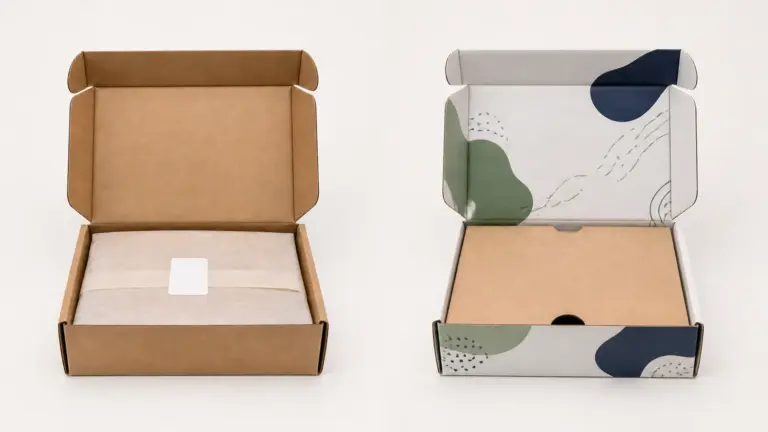
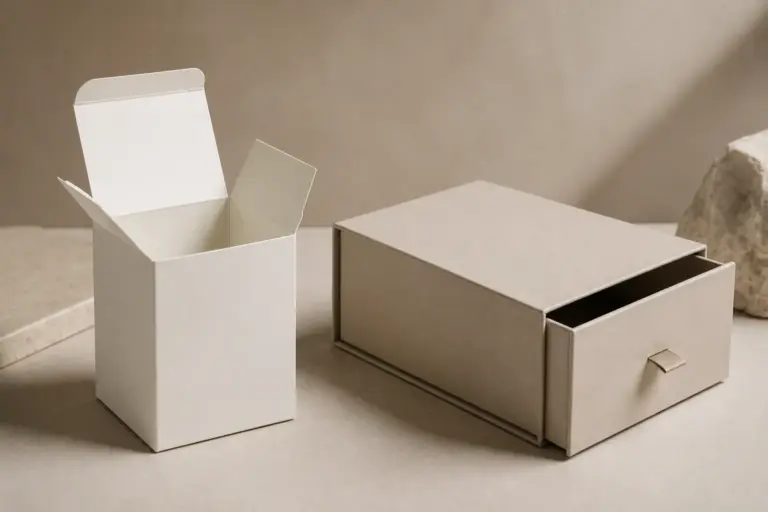
Use a folding carton when flat delivery, compact retail packing and a printable paperboard surface fit the job. Use corrugated packaging when the pack needs a fluted structure for shipping or higher stacking demands. Consider a rigid box when the opening and presentation justify assembled volume and added conversion.
The folding carton versus rigid box guide provides a direct comparison.
5. Select the board from performance and print needs
Board names are not complete specifications. Identify grade, caliper or flute, surface shade, print requirement, fold behavior and any documented recycled-content or fiber claim. A smoother white board and an uncoated kraft surface will not reproduce the same artwork in the same way.
The packaging paper guide translates common cardstock, paperboard and cardboard terms.
6. Define print coverage and color control
Provide the correct artwork revision, print process if known, number of colors or color system, inside/outside coverage and any physical reference. Large dark solids, fine reversed text and tight registration require different review from a simple one-color mark.
7. Add finishes only after the surface is fixed
Foil, embossing, spot UV, varnish and lamination affect cost, tooling, registration, durability and fold behavior. State location and acceptance criteria. A finish should support hierarchy or handling performance; it should not be used to compensate for an unresolved structure.
8. Design the insert with the product
An insert controls movement and removal. Choose its material from product weight, fragility, cavity geometry, packing speed, presentation and transport risk. Approve the product, insert and outer box together.
9. Separate quantity from artwork versions
List the total quantity and the quantity by size, SKU and artwork. Tooling may be shared while print setup, proofing, sorting or packing remains separate. Ask which operation sets the MOQ and unit economics.
10. Approve a production-relevant sample
A plain sample can answer structure and fit questions. A printed prototype can review artwork direction. A pre-production sample may be needed when the exact board, finish or assembly must control production. Record the approved revision rather than approving an unnamed image in a message thread.
11. Specify packing and destination
Confirm flat or assembled delivery, units per carton, protection, shipping marks, pallet or carton constraints, delivery destination and commercial term. Packaging cost and performance continue after conversion.
Decision-ready brief
A supplier can evaluate the project when the brief identifies the product, structure, internal dimensions, board/performance basis, print, finish, insert, quantity by version, sample requirement, packing and destination. If one item is unknown, describe the required outcome and ask the supplier to state its assumption.