Soap Sleeves vs Boxes: Choosing Packaging for Retail and Online Orders
A useful soap-packaging sample review covers product visibility, label space, fit and packing work—not just the appearance of the printed band or box.
Choosing between soap sleeves vs boxes starts with how much of the bar you need to enclose. A paper sleeve leaves part of the soap exposed; a folding carton covers more of it and offers additional panels for information. Neither format, by itself, is a complete parcel-shipping system. The useful comparison is the finished bar, the retail presentation and the outer packaging working together.
A sleeve can be a sensible choice for a bar that customers should see before buying. A carton deserves a closer look when the product will be handled repeatedly, stocked alongside other products or sold with more information than a narrow band can comfortably carry. Test those assumptions with actual soap before committing to artwork or a production quantity.
What counts as a soap sleeve?
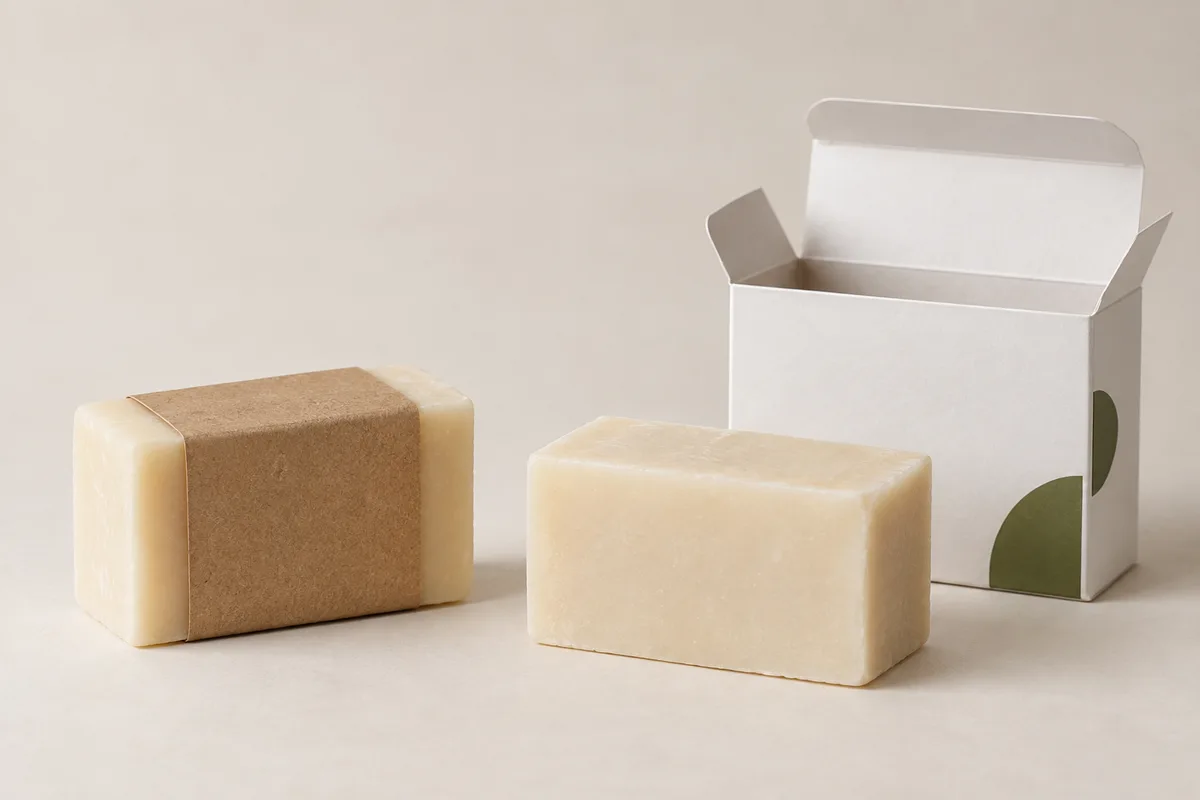
In this article, a sleeve means a paper or paperboard band that wraps around the bar while leaving its ends exposed. Soap makers also call this a cigar band. Bramble Berry's cigar-band definition describes that partial coverage. The term does not mean a plastic shrink sleeve, a sealed wrapper or a full folding box.
A soap carton has connected panels and closures that enclose the product more fully. A carton with a window is a separate configuration: it exposes a view of the bar, but its construction, window material and handling requirements need their own review. Ask for a structural sample rather than relying on the word “box” in a quotation.
Compare the selling conditions, not just the appearance
For retail display, look at how a shopper will pick up, turn and put down the package. A band can show the surface and shape of the bar, but the exposed areas remain available for contact. A carton provides more enclosure, although it is not automatically sealed or tamper-evident. If either of those functions is required, specify it separately.
The right choice can differ between sales channels. A product sold directly at a staffed counter may not need the same presentation as a bar sent through a fulfillment operation. Keep the product and brand consistent, but do not assume the packaging must be identical when the handling environment changes.
| Decision | Paper sleeve or band | Folding soap carton |
|---|---|---|
| Product visibility | Exposes part of the bar directly | Usually conceals the bar unless a window is specified |
| Information area | Limited to the band and any additional label | Several panels, subject to closures and artwork layout |
| Fit check | Must stay in position without damaging the surface | Must load, close and retain the bar without excessive movement |
| Handling | Exposed soap can contact hands and adjacent packs | Encloses more surfaces but is not a sealed barrier by default |
| Online orders | Needs an appropriate outer shipping arrangement | Still needs an appropriate outer shipping arrangement |
| Packing work | Wrapping, positioning and securing the band | Erecting, loading and closing the carton |
This table compares functions, not prices or environmental performance. Those require the proposed material, dimensions, print, assembly method and quantity.
Size the packaging around the soap as sold
Measure finished bars in the condition in which they will be packed. A mold dimension or an early sample may not represent the product supplied to the packing team. Where the bar varies, record a practical range from the samples available rather than sending one ideal dimension and assuming every bar matches it.
For a sleeve, examine the perimeter that the band must follow. Check whether the soap has square corners, rounded edges, a raised stamp or an uneven top. A design that looks tidy on a drawing may slide over a smooth bar or catch on a decorative feature. Avoid solving a loose band simply by making it tighter without checking loading and surface contact.
For a carton, distinguish internal space from outside dimensions. Confirm the loading direction and where the closure passes over the product. A tall decorative top may require a different orientation even when the overall length and width appear suitable. The custom box dimensions guide explains the measurement conventions to establish with a supplier.
Packaging should not be used as a substitute for the product maker's decisions about formulation, curing, moisture or storage. Those conditions vary. Tell the packaging supplier what the finished product will encounter instead of asking a paper band or carton to correct an unresolved product issue.
Make room for the actual label copy
Put the real text into the first artwork layout. Placeholder copy makes a narrow band look easier to use than it may be once the brand adds product identity, variant information, batch identification and the statements required for its market.
Do not solve crowded artwork by making everything smaller. Check which information belongs on the main display area and which can use another panel. A carton gives the designer more options, but folding tabs, glue areas and closures are not interchangeable with uninterrupted reading surfaces.
The brand should confirm the applicable labeling requirements with suitable regulatory support. This comparison is not a labeling-compliance checklist, and the presence of extra panels does not make a carton compliant automatically. Keep the approved copy linked to the packaging revision so that an old ingredient or product description is not reused accidentally.
Review the complete online-order pack
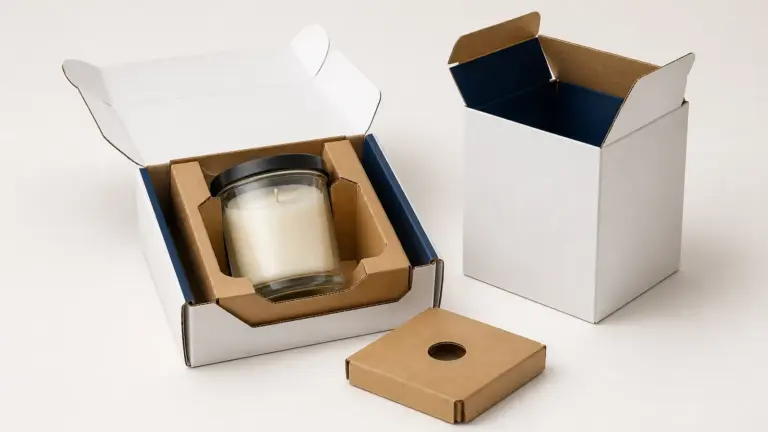
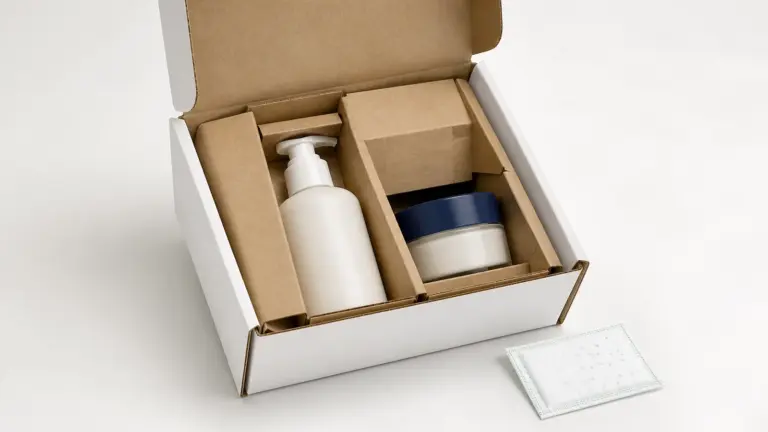
A retail soap box and a shipping box do different jobs. Place the proposed retail package inside the actual mailer or shipper, together with the other items normally included in the order. Look for movement, rubbing, crushing and contact between products. Check mixed orders as well as a single bar packed by itself.
A sleeve may need a separate protective wrap or separation from neighboring products. A carton may still move around the outer box or have a closure disturbed during handling. These are reasons to test the complete arrangement, not proof that one format is always unsuitable for ecommerce.
Ask the fulfillment team to pack and unpack the sample. Their feedback can reveal awkward assembly, labels hidden by the outer pack or a presentation that takes too long to restore after opening. A packaging choice should work at the bench as well as in a product photograph.
Compare packing work before comparing unit prices
Request quotations for defined alternatives. State whether sleeves arrive flat, pre-glued or otherwise assembled, and whether cartons require manual erection. Include any labels, wraps or separators needed for the intended selling channel. An inexpensive component can leave additional work elsewhere in the process.
Run a small observed packing trial with each sample. Record what the operator actually does, where the product needs adjustment and whether the finished presentation is repeatable. Do not publish a universal assembly-time estimate from a trial with one operator or one soap shape.
If several fragrances share a structure, ask how artwork versions affect the order. Separate the total run from the quantity per version, and confirm how the supplier will identify the different packs. This is a version-control question as much as a price question.
Use a short sample decision record
Keep the following record with the physical samples:
- Bar condition: finished product version, measured range and any raised or irregular surfaces.
- Selling channel: staffed retail, shelf display, online orders or a defined combination.
- Fit observations: sleeve movement, loading resistance, closure interference and visible contact marks.
- Information check: actual copy fitted, readable orientation and approved variant identification.
- Packing observations: extra components, handling steps and outer-package arrangement.
- Decision: selected configuration, unresolved questions and the person responsible for approval.
The record does not need to be elaborate. Its purpose is to preserve why a configuration was selected, particularly when a reorder changes the bar, artwork or delivery channel.
Prepare the soap packaging brief
For a product-specific discussion, start with the bar rather than a preferred box photograph. Send the finished dimensions, a sample or clear product images, the intended channel, the label copy and the quantity for each version. Note whether the soap must remain visible and what outer packaging is already in use.
Explore custom soap packaging boxes to compare the available structural direction, then request a packaging quotation for the configuration you want evaluated. Keep sleeve and carton options separate in the brief so the quotations describe genuinely comparable work.
Image note: the featured image is an AI-generated illustration of a paper band and folding carton, not an approved fit sample or customer project.