How to Package Skincare Products for Shipping
Learn how to package skincare products for shipping with filled-container checks, closure clearance, leak control, inserts and route testing.
A skincare parcel can look undamaged outside while the contents fail inside. A pump may discharge under pressure, a dropper cap may loosen, a jar may rotate until its label scuffs, or one leaking item may soak the cartons and instructions around it.
The shipping package cannot correct an incompatible primary container, but it can keep approved closures from being actuated, control movement and limit the consequences of a failure. The design process starts with filled production-equivalent containers and the actual order mix—not with a generic “beauty box” reference.
The focus here is the shipping problem. PackagingFor’s custom cosmetic box packaging page covers the commercial choice of folding cartons, presentation boxes and other branded structures.
Clear the primary pack before designing the shipper
Formula-container compatibility, closure torque, seals and storage stability belong to the product and quality program. A secondary paper package is not evidence that those controls are adequate.
Before structural work begins, confirm that the shipping samples represent the approved or production-equivalent primary pack. Record:
- filled weight and normal tolerance;
- bottle, tube or jar dimensions;
- pump, dropper, cap or lid height;
- closure application and tamper features;
- required orientation;
- glass, ceramic or thin-wall risk;
- label and decoration rub sensitivity;
- formula staining or leakage consequences;
- accessories and instructions shipped with the item.
Empty display bottles can hide the real load and leakage behavior. Use filled samples whenever safe and feasible, or use controlled substitutes that reproduce weight and center of gravity while clearly recording the limitation.
Prevent the closure from becoming a load point
A pump or dropper should not carry vertical load from the insert or lid. Leave controlled clearance above the actuator and keep side tabs away from moving closure parts. If a cap can loosen through rotation, retain the container body without turning the cap into the gripping point.
Turn the packed sample onto every side. Check whether the product slides upward, whether a lid contacts the mailer and whether a top card presses a pump. Repeat after vibration or handling evaluation because a component that begins clear may migrate during transit.
The insert also needs safe removal. A tight cavity that forces the customer to pull on a dropper or pump creates a new failure at unboxing. Add finger access around a structurally sound part of the container.
Separate containment from cushioning
Cushioning limits mechanical shock; containment limits the spread of a leak. One component does not automatically perform both jobs.
If leakage is a credible failure mode, decide what the secondary system must do. It may need to keep a bottle upright, separate the item from paper instructions, contain liquid within an inner component or make a loose closure visible during packing. Absorbent or barrier materials should be selected and validated for the formula and disposal requirements; they should not be added as an untested symbol of protection.
Do not claim that a corrugated or paperboard box is leakproof unless the complete construction has been tested and supports that statement. Most paper components will show staining or loss of strength after liquid exposure.
Restrain bottles, jars and tubes differently
A tall bottle needs control against tipping and vertical lift. A glass jar presents a dense load with a broad base. A tube can deform if a tab or partition presses the wall. Airless packs and droppers may have delicate closure features.
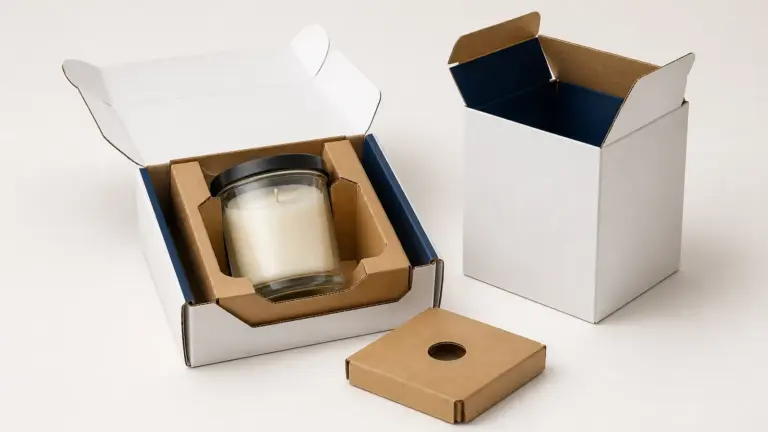
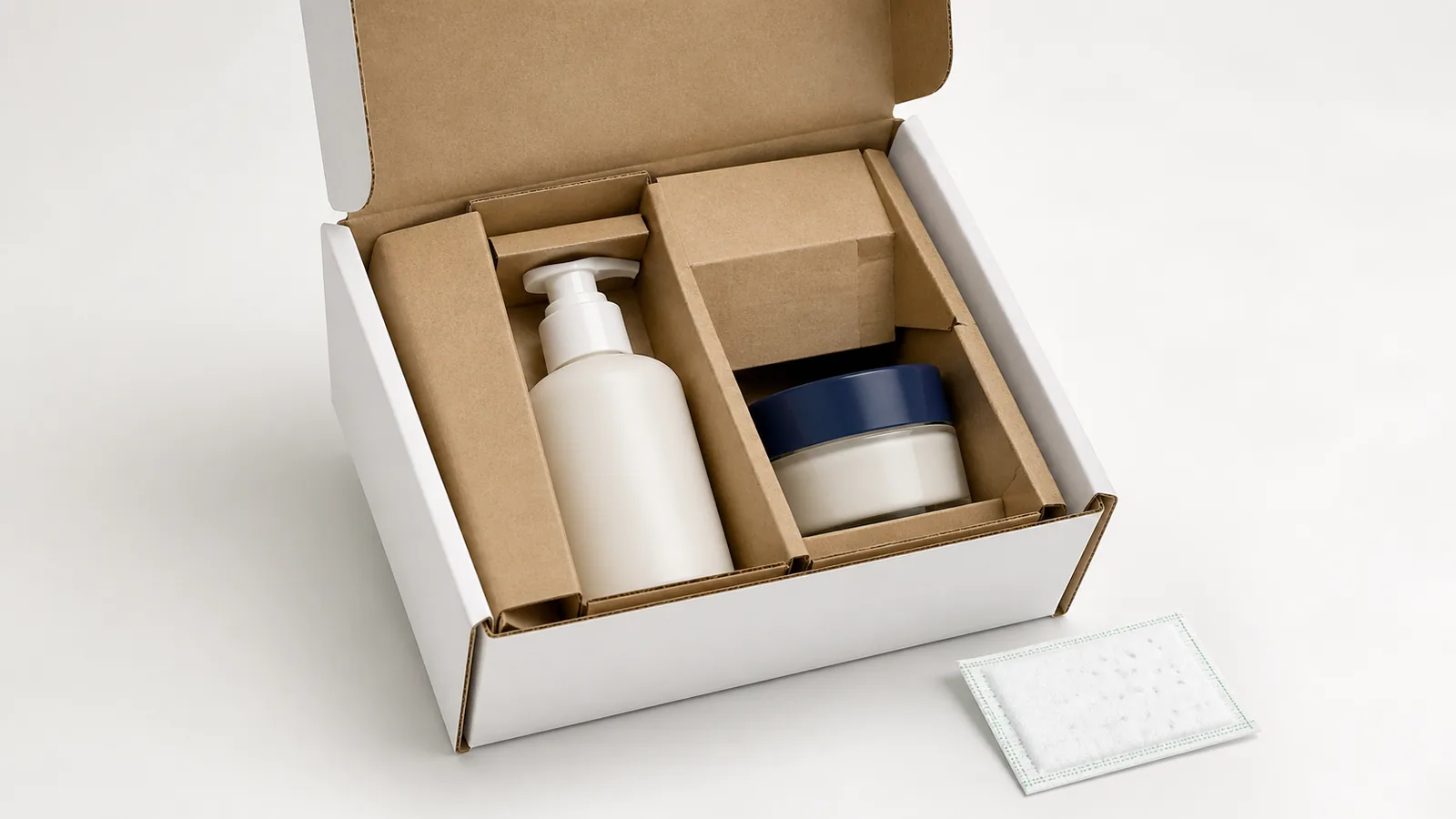
For each item, identify safe contact zones and the motion that needs to be stopped. Common paper-based structures include:
- a folded platform with openings for light containers;
- side rails around rectangular cartons or jars;
- a shoulder collar that avoids the closure;
- corrugated partitions between glass items;
- a base cradle with a separate top pad;
- modular dividers for changing routine sets.
Material follows the function. PackagingFor’s insert-material guide compares the main insert families; the shipping approval still belongs to the exact product, cavity and outer box.
Size the mailer from the loaded arrangement
Arrange the heaviest items low and keep unlike components from striking each other. Once the insert is erected and loaded, measure its finished outside dimensions. Folded tabs and product pressure can make the insert larger than its flat CAD size.
The mailer needs enough clearance to close without crushing the insert, but not so much that the complete assembly slides. Check lid depth, dust flaps, locking tabs and any printed card. If the branded mailer travels without another outer carton, reserve a practical zone for the shipping label and expect some exterior handling wear.
One mailer size may serve several skincare routines only if the smallest and largest configurations are controlled. Avoid designing for the largest set and filling every smaller order with loose material. A second insert or mailer size can create a cleaner, more repeatable pack-out.
Protect labels and decorative finishes
Matte coatings, metallic decoration, dark labels and soft-touch surfaces can show rub quickly. Contact with uncoated board, paper dust or another container may be unacceptable even when the vessel itself is intact.
Use production label materials in the test. Inspect the pack after insertion, vibration, removal and warm or humid conditioning appropriate to the route. If a paper wrap or tissue touches the product, check for color transfer and abrasion.
Keep decorative surfaces away from hard die-cut edges. A small folded rail or unprinted contact zone may solve more than adding a full presentation layer.
Build a packing check that catches mistakes
The shipping design should help the fulfillment team identify a loose cap, missing item or wrong orientation before the lid closes.
A practical station check can include:
- confirm the product and closure revision;
- inspect cap, pump lock or tamper feature;
- wipe and inspect the container exterior;
- load the item in the marked orientation;
- verify every cavity is occupied;
- add the correct instructions or regulated documents;
- close and seal the mailer using the approved method.
Time this process during the structural trial. A beautiful insert that requires excessive force or interpretation will generate packing variation. Do not rely on a printed arrow if the product can still be loaded incorrectly.
Keep labeling review separate from shipping engineering
Shipping packaging can provide space for information, but it does not decide which statements are legally required. For products sold in the United States, the FDA provides a summary of cosmetics labeling requirements. Requirements depend on the product and claims; some skincare products may also be regulated as drugs.
The responsible brand and qualified advisors should approve labels, warnings, claims, coding and destination-market requirements. The packaging supplier should maintain the agreed panel sizes, materials and artwork revision. Do not redesign a critical information panel during a shipping test without reopening the formal artwork review.
Test the filled product-package system
A flat carton proof and an empty mailer sample cannot establish shipment performance. Assemble the finished container, closure, label, insert, documentation and sealed mailer, then evaluate the system for the intended route.
The International Safe Transit Association lists test procedures for different distribution environments in its official overview. Select the program according to the actual channel and risk. Before testing, define failure: breakage, leakage, pump actuation, closure movement, label scuffing, unacceptable carton staining, insert release or exterior damage beyond the brand’s limit.
Review actual shipment feedback after launch. Retest or reassess when the container, formula fill, closure, label, insert, mailer or packing process changes. The evidence applies to the tested configuration, not to every skincare item placed in the same style of box.
Prepare the RFQ around the shipment
Provide filled product samples, dimensional tolerances, closure details, normal and maximum order combinations, complete packed weight, required orientation, insert function, route, test criteria, quantity, artwork versions, delivery destination and schedule.
State whether individual retail cartons already exist and whether they are part of the shipped configuration. If quotations assume different layers or packing states, their unit prices are not directly comparable. PackagingFor’s custom packaging RFQ checklist helps keep those commercial fields aligned.
Design outward from the filled container
The dependable sequence is primary-pack approval, shipping-risk review, insert geometry, outer-box sizing, pack-out trial and route-based testing. PackagingFor manufactures custom cosmetic packaging boxes and paper-based inserts, but a productive shipping brief begins with the filled bottle, jar or tube and a clear description of what must not happen in transit.