Stock Boxes vs Custom Boxes: When Should a Small Business Upgrade?
Stock boxes vs custom boxes: compare volume, fit, labor, brand control and total cost to decide when a small business should upgrade.
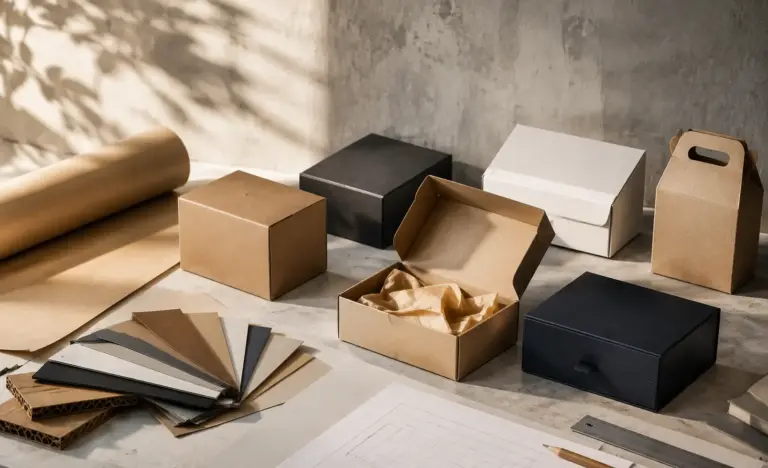
For a young brand, packaging rarely changes in one clean jump from a brown carton to a fully printed box. The usual progression is more practical: stock packaging first, a label or stamp once the identity settles, and custom print only after the order pattern becomes predictable.
Stock boxes are the safer choice while products, bundles or volumes are still moving. A custom box starts to earn its place when the same pack-out repeats often enough to reduce labor, empty space or presentation inconsistencies. That is the decision this comparison addresses. It is not a contest between “basic” and “premium.”
A sensible progression, not a leap
Most growing brands do not move directly from an unbranded carton to an elaborate rigid box. They pass through three stages.
| Stage | Typical system | Best fit | Main limitation |
|---|---|---|---|
| Stock | Off-the-shelf box, mailer or carton | Early testing and changing products | Generic fit and appearance |
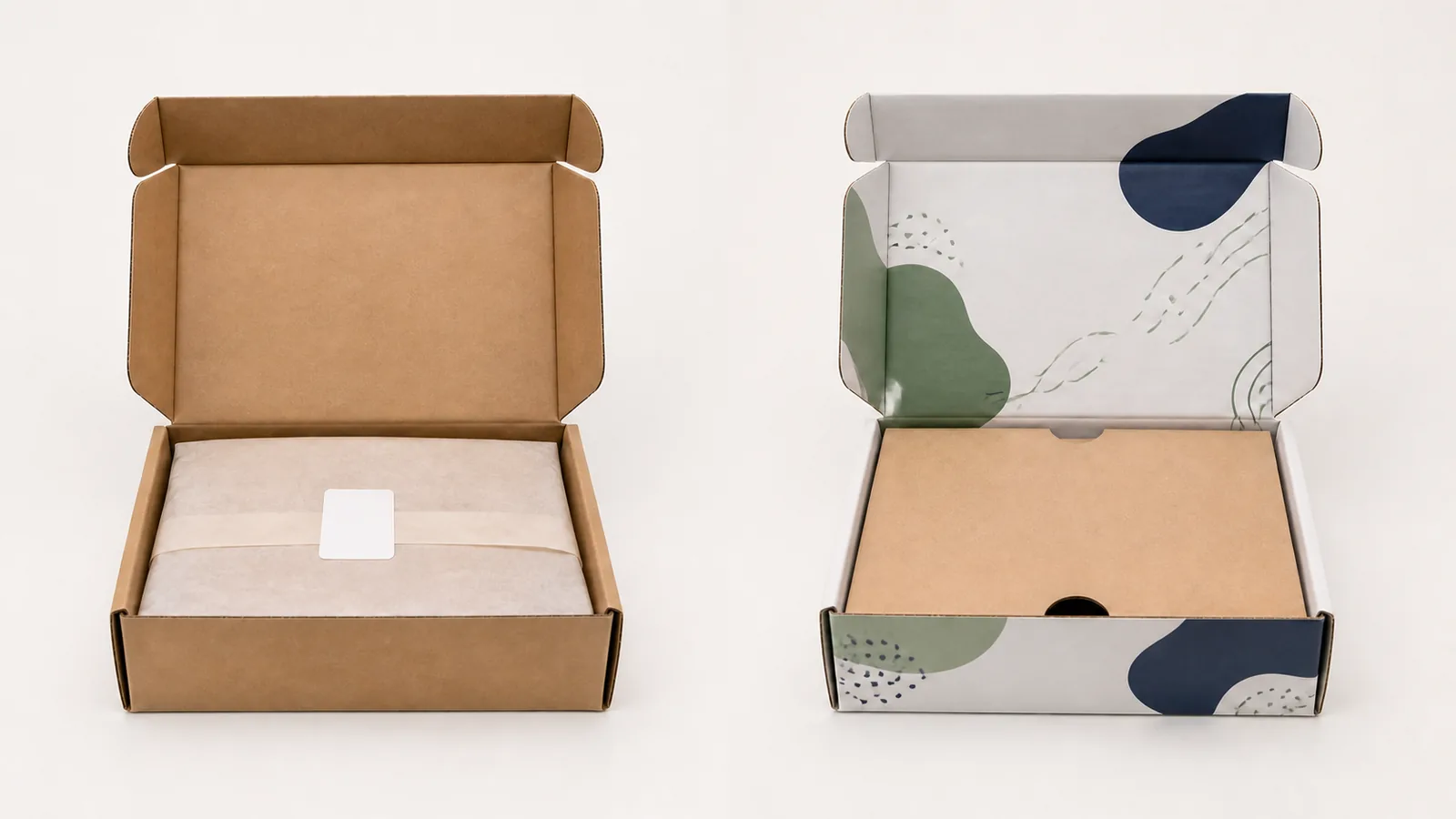
| Branded stock | Stock box plus sticker, stamp, tape, sleeve or insert card | Low-volume brand consistency | Extra packing labor and limited print area |
| Fully custom | Made-to-size structure with direct printing and optional insert | Stable product, repeat orders and controlled presentation | Setup, MOQ, lead time and storage commitment |
Staying at stage one or two can be the commercially sound decision. A right-sized stock box that protects the product is more useful than an attractive custom box that is awkward to pack or obsolete after the next product revision.
Choose stock packaging when uncertainty is high
Stock packaging is strong when flexibility matters more than precise fit. It allows a business to change product bundles, test demand and buy several sizes without committing to a die line. It is also easier to replace quickly when a launch sells faster than expected.
Stock boxes are usually the better choice when:
- monthly order volume changes sharply;
- product dimensions or bundles are still evolving;
- fewer than several months of usage can be forecast confidently;
- packaging storage is limited;
- artwork is not final;
- the product already has a strong retail carton and only needs a shipper;
- a label, stamp or printed tape can provide enough identification.
The trade-off is labor. A sticker, stamp and folded sheet of tissue may be insignificant at 20 orders a week. At 500, those same actions become a line item. A five-minute timed packing trial is more informative than assuming manual branding is free.
Branded stock packaging is a useful middle stage
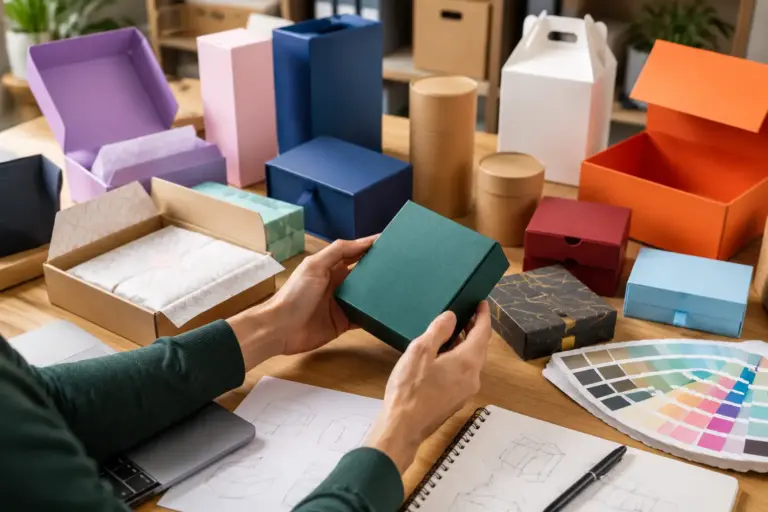
A disciplined stock system often gives a small business most of the visible brand benefit without committing to a production run. Limit the number of box sizes, then build a small component set around them: one label format, one tape width and an insert card that works across the range. The discipline matters more than the number of decorative pieces.
It also creates the operating data needed for a proper custom brief:
- which box size is used most often;
- which products are commonly ordered together;
- how much void fill is required;
- where damage occurs;
- how long each order takes to pack;
- how many boxes can be stored and replenished;
- which messages customers actually see during unboxing.
One deliberate brand moment is usually stronger than five components assembled differently by every packer.
The case for custom is operational
Direct print is only the visible part of a custom program. Dimensions, closure, opening sequence, insert and packing method can all change. In practice, those structural decisions often create more value than an additional color on the lid.
Consider requesting a custom design when several of these conditions are true:
- One product or bundle represents a large share of shipments.
- Current boxes require excessive void fill or allow product movement.
- Staff repeat the same manual branding steps on every order.
- The package is a visible part of the product experience.
- The brand can use the expected quantity before the artwork or product changes.
- A custom insert can replace multiple loose protective parts.
- Inbound cartons, pallet space and packaging storage can be planned.
A made-to-size box can still be wrong if it is designed from the product’s nominal dimensions alone. Measure the finished item at its largest condition, include accessories and instructions, define the required clearance, and decide whether the retail package will ship inside an outer mailer.
Compare total cost, not only the unit price
The lowest quoted price per box may not be the lowest packaging cost per shipped order. Build a simple comparison with the same demand period and product mix.
Include:
- box or carton price;
- tooling, plates and sampling;
- labels, tape, tissue, void fill and insert cards;
- assembly and packing time;
- inbound freight and duties where applicable;
- storage and handling;
- damage, replacement and reshipment data;
- unused packaging caused by artwork or product changes.
Do not assign savings that have not been measured. If a custom insert is expected to reduce pack time, run a timed pilot. If a smaller box is expected to change carrier charges, compare the packed outside dimensions and actual rate rules. PackagingFor’s custom packaging cost guide explains the main quote drivers, while the MOQ guide explains why production minimums vary.
Run the numbers before requesting artwork
Before asking suppliers to quote, complete this six-line worksheet:
- Average monthly units for the target product or bundle:
- Expected months before a product or artwork change:
- Current box, branding component and void-fill cost per order:
- Current packing time per order:
- Current packed outside dimensions and weight:
- Current damage or repack reason:
Then request quotes for the same quantity breaks and the same packaging scope. One supplier may quote only the printed box while another includes an insert, proof, tooling or delivery. PackagingFor’s RFQ checklist helps keep those offers comparable.
Do not let low MOQ become the only requirement
“Custom packaging no minimum” and “low MOQ custom packaging” are common searches because small brands want to control cash. But the smallest possible run can carry a high unit cost and may not validate production consistency. The better question is: what is the smallest sensible run for this structure, print method and expected usage?
Ask suppliers to separate three options:
- a digitally printed short run using an existing structure;
- a custom-size run with limited print coverage;
- a full production run using the intended material and print process.
The options may not look identical. A prototype or digital short run can be suitable for checking size and artwork, but it should not silently be treated as proof that every production characteristic will match. See the custom packaging prototype guide for a clearer approval sequence.
What to send for a useful custom packaging quote
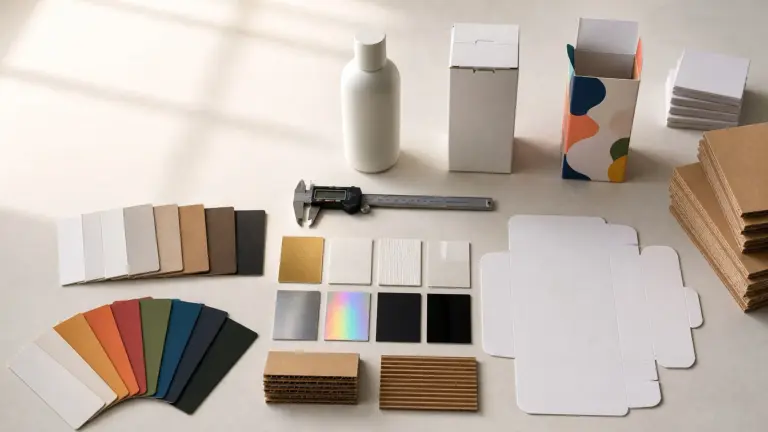
When the upgrade case is real, send more than a logo. A supplier needs the product dimensions and weight, packed orientation, quantity and quantity breaks, box style, material or performance requirement, print coverage, finishes, insert needs, delivery destination and required date. Identify which details are fixed and which can be engineered.
If you are unsure about the structure, share photographs of the product and current packing method, but do not rely on photographs for scale. Provide measured dimensions and a physical sample when fit is critical.
Questions buyers usually need to settle
Are custom boxes always more expensive?
Not on every basis. A custom box can carry setup and inventory costs but may reduce labels, void fill, labor or unused space. Compare the total cost per shipped order using your own packing and carrier data.
Should a new business start with custom packaging?
Only when the product, order volume and brand system are stable enough to use the run. Otherwise, a disciplined stock system can protect cash while collecting better specifications.
Can stock boxes still look intentional?
Yes. Labels, stamps, tape, sleeves, tissue and insert cards can create a consistent identity. Limit the component count so the pack-out remains fast and repeatable.
What is the clearest signal that it is time to go custom?
Request one when a repeatable product or bundle has measurable fit, protection, packing or brand needs that stock packaging does not solve.
Move forward with a controlled brief
When the packing data supports a custom run, PackagingFor can compare folding cartons, mailers, rigid boxes and inserts against the same brief. Review the custom packaging services and keep the specification consistent across every quote.