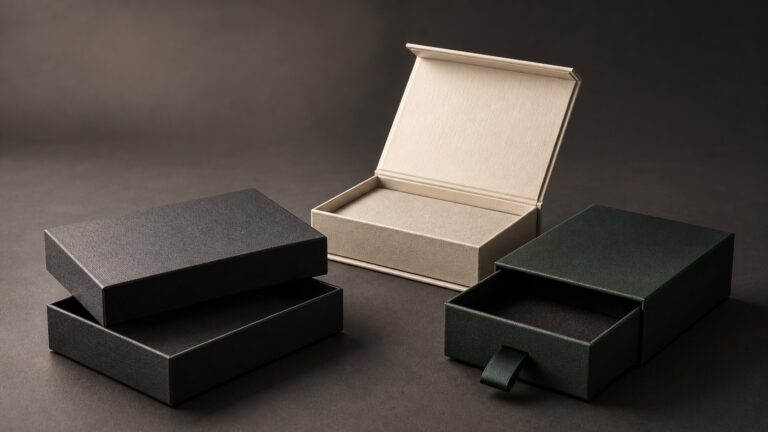

Folding Carton Specification Guide for Packaging Buyers
Build a production-ready folding carton specification covering dimensions, board grade, caliper, dielines, print, finishes, tolerances, samples, inspection and packing.
Quick answer: A folding carton specification is the technical record used to quote, sample, manufacture and inspect a paperboard carton. It should define the internal dimensions, carton style, board grade and caliper, grain direction, print colors, coating, finishing, closure, insert, tolerances, packing method and approval sample. Clear specifications allow buyers to compare suppliers on equivalent requirements.
This guide is for packaging buyers, designers and operations teams preparing a production brief. If you are looking for available box styles, materials and manufacturing support, visit our custom folding cartons product page. The sections below focus on technical decisions and documentation rather than supplier selection.
When a folding carton is the right format
Choose a folding carton when the product is relatively light, the package will be displayed on a shelf or placed inside a shipping container, and flat storage matters. Choose corrugated packaging when the box itself must carry parcel hazards. Choose a rigid set-up box when structural permanence and luxury presentation justify higher material, assembly and freight costs. If you are comparing those premium formats, read our folding cartons versus rigid boxes guide.
| Carton style | Best fit | Specification checkpoint |
|---|---|---|
| Straight tuck end | Cosmetics, skincare, small retail products | Both tucks close in the same direction; confirm the main display panel |
| Reverse tuck end | Lightweight high-volume products | Opposing tuck directions can improve sheet layout |
| Auto-lock bottom | Heavier items or faster hand packing | Confirm bottom load, pre-gluing and opening sequence |
| Snap-lock bottom | Moderate weight and manual assembly | Validate base strength and the number of folding steps |
| Sleeve | Trays, product sets and visual reveals | Define the second component and finished-fit tolerance |
| Window carton | Products that benefit from visibility | Specify window size, film, glue area and recycling goals |
Begin with internal dimensions and packing behavior
State dimensions as internal L × W × H and identify which panel is the front. Measure the real sellable unit, including seals, labels, pumps and protective bags. Then decide whether the product needs an insert, platform, partition or simple friction fit. Paperboard has thickness; folds consume space; bottles and jars vary. The structural designer should include realistic clearance and production tolerance instead of merely matching a CAD model.
Packers also need room to work. A carton that is technically large enough may still be slow if a flap catches on a pump or if the product has to be forced past a narrow opening. During sample approval, time several assembly cycles and test the least experienced packer. If the project uses automated cartoning, provide machine drawings, glue flap position, opening force and blank orientation before the dieline is created.
Select board by performance and print surface
Common options include solid bleached sulfate (SBS) for a clean white premium surface, folding boxboard (FBB) for a balance of stiffness and printability, coated recycled board for recycled-fiber content, and kraft board for a natural brown appearance. Names vary by market, so request the mill or supplier grade, caliper, basis weight and relevant documentation on the quote or sample record.
GSM alone does not predict stiffness. Fiber composition, caliper, moisture, grain direction and panel size all matter. Long unsupported panels need more stiffness than a compact cube. Grain direction should support clean folding and resist panel bowing. Heavy ink coverage, lamination and foil can change fold behavior, which is why the production-representative sample matters.
For a broader material comparison, see our packaging paper guide.
Define printing and color requirements
Offset lithography is widely used for high-quality paperboard cartons because it reproduces fine graphics efficiently at production quantities. Digital printing can be useful for short runs, launch tests and multiple versions. The correct choice depends on quantity per artwork, color expectations, board, finish and schedule—not on a universal quality ranking.
Supply vector artwork in CMYK or specified spot colors. Identify critical brand colors with approved references and agree on how they will be evaluated under controlled light. Rich black, small reversed type, fine rules and large solid areas need prepress attention. Uncoated kraft will absorb ink and mute color; a coated white board produces a different result. Approve against the actual substrate whenever color carries commercial risk.
Specify closures, glue and inserts
Tuck flaps are suitable for many retail packs, while seals, labels or glue may be required for tamper evidence or distribution. Auto-bottom cartons include pre-glued panels and open quickly. Sleeves rely on controlled friction. If a carton holds a bottle, jar or device, a folded paperboard insert can position the product and reduce movement without automatically adding a different material stream.
Specify whether the carton is supplied flat, pre-glued, erected or packed with an insert. Show the filling direction. Define master-carton protection so edges and corners are not crushed during international transport. The package should be evaluated after the same assembly and shipping conditions it will encounter in launch—not only as a pristine press sample.
Document finishes and registration tolerances
Matte or gloss lamination changes the overall surface and scuff behavior. Water-based coatings or varnishes can add protection with a different material profile. Foil stamping creates metallic or pigmented accents. Embossing and debossing add relief. Spot UV creates selective gloss. Each special finish needs its own artwork layer, registration tolerance and sample approval.
Use finishes to guide attention, not to decorate every panel. A small foil focal point on a stable surface is usually easier to control than a detailed foil pattern crossing scores. Deep embossing near a fold can weaken or distort the panel. Film laminates may affect a recyclability claim or local acceptance of the finished pack, so validate both performance and marketing language before committing.
Follow a controlled prototype and approval sequence
- Dieline review: confirm internal dimensions, panels, cut lines, scores, glue area and orientation.
- Plain structural sample: test fit, closure, assembly and shelf stance with production products.
- Artwork preflight: verify bleed, safe area, color, fonts, linked images, barcodes and finish layers.
- Printed proof or sample: evaluate content, color expectation, finish placement and crease behavior.
- Golden sample: identify the signed reference for production and define acceptable tolerances.
- Packing test: confirm master-carton quantity, orientation, labels and transit protection.
Packaging-specific preflight should verify the dieline version, bleed, safe areas, color definitions, overprint and finishing separations. Esko’s packaging prepress workflow explains why these checks must be tailored to the job.
Build a comparable technical specification
Record the same variables for every quotation: internal size, style, board grade and caliper, print process and colors, coating or lamination, special finishes, insert, gluing, quantity per artwork, overs/unders policy, flat packing, master-carton quantity, palletization, quality criteria, sample plan, lead time, freight term and delivery location. Otherwise a lower price may simply exclude a material or production step.
Tooling and setup are spread over the run, so quantity influences unit price. However, ordering more cartons than a forecast supports can turn a low unit price into obsolete inventory. Review our packaging MOQ guide before locking the volume.
Folding carton specification checklist
| Field | What to record |
|---|---|
| Product | Dimensions, packed weight, orientation and special protection needs |
| Carton | Internal L × W × H, style, front panel and filling direction |
| Board | Named grade, caliper, GSM or basis weight, grain direction and color |
| Process, number of colors, spot-color references and inside printing | |
| Finish | Coating, lamination, foil, embossing, debossing or spot UV |
| Conversion | Die-cutting, scores, perforations, glue and opening requirements |
| Insert/window | Material, dimensions, fit, film and assembly method |
| Quality | Critical tolerances, defect criteria, barcode checks and approval sample |
| Packing | Flat or erected, quantity per master carton, labels and pallet plan |
| Commercial inputs | Quantity by artwork, delivery destination, freight term and required date |
Frequently asked questions
Can a folding carton be used as a shipping box?
Usually it is retail or inner packaging, not a parcel shipper. If it must enter a courier network without an outer box, the complete pack needs distribution testing and may require corrugated construction.
What board thickness should I specify?
There is no single best caliper. Provide product weight, panel size, distribution route and desired feel; then approve a named grade and physical sample.
Do I need an auto-bottom carton?
It is valuable when base strength or packing speed offsets the added converting cost. For light products and lower packing volumes, a tuck or snap-lock style may be sufficient.
Can folding cartons use recycled paperboard?
Yes, depending on appearance, stiffness, print and product requirements. Request documented recycled content and test the actual grade rather than relying on a generic label.
What is a golden sample?
It is the approved physical reference used to align expectations for production. The specification should identify which characteristics it controls and any agreed tolerances that cannot be judged from the sample alone.
Prepare a production-ready folding carton brief
Use the checklist above to record product, structure, board, artwork, finishing, quality and delivery requirements before requesting prices. Packaging For can review the completed brief, develop a dieline and recommend an appropriate sample path. Submit the specification through our custom packaging quote form.