Custom Mailer Boxes for Ecommerce: A Practical Buyer’s Guide
A practical sourcing guide to custom ecommerce mailer boxes, covering structure, board, sizing, printing, protection, testing and quote requirements.
Quick answer: Custom mailer boxes for ecommerce work best when one corrugated structure can protect the product, communicate the brand and ship without an additional retail carton. The right specification starts with the packed product—not the artwork—and balances internal fit, flute, board strength, print method, closure, insert and parcel-test requirements.
Looking for a production quote? Review our custom mailer boxes capabilities, then send the product dimensions, quantity, destination and artwork status through the quotation form.
A mailer box can look simple on a screen, yet small structural choices change its cost and performance. A shallow skincare kit needs a different flute and insert from a heavy subscription box. A beautiful box that arrives crushed is not premium packaging; an overbuilt box that carries unnecessary dimensional weight is not efficient packaging. This guide explains the decisions a North American ecommerce buyer should settle before requesting a production quote.
What is a custom ecommerce mailer box?
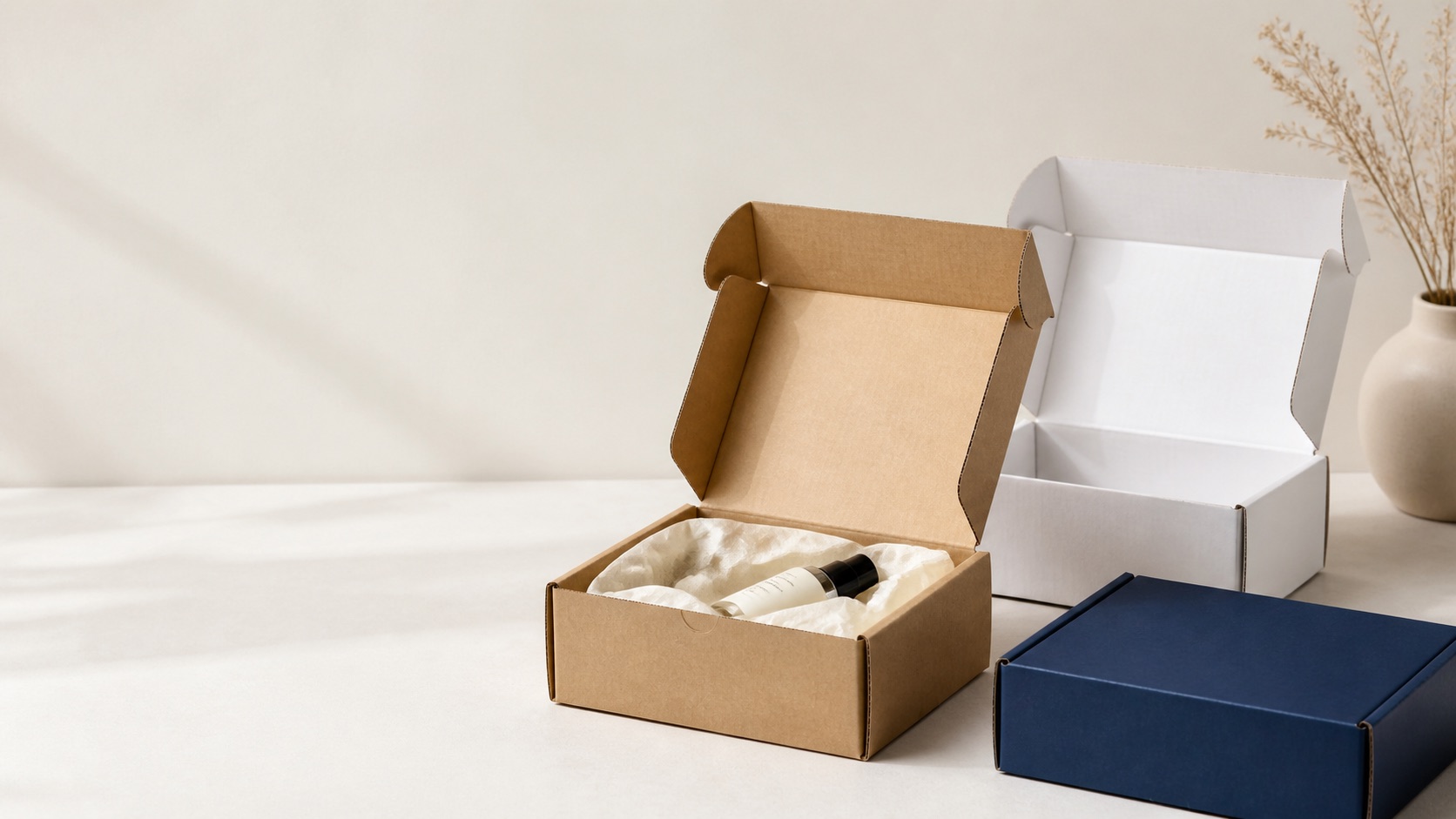
A mailer is usually a one-piece, die-cut corrugated box with a hinged lid, side dust flaps and a roll-end front-tuck closure. It normally ships flat and locks into shape during fulfillment. Unlike a thin folding carton, corrugated board includes a fluted middle layer that adds stiffness and cushioning. Unlike a regular slotted shipping carton, a mailer creates a more controlled unboxing presentation and may need little or no tape for light products.
The key word is system. The box, product, insert, void fill, closure, label position and transport method should be designed together. UPS advises shippers to use a rigid box, select cushioning that limits movement and stay within the box maker’s weight limit; corrugated liners and inserts can also increase strength. These principles apply whether the outer surface is plain kraft or full-color printed. See the carrier’s current packaging guidance before approving a direct-ship format.
Choose the structure around the fulfillment job
Most branded ecommerce mailers use a roll-end front-tuck style, but the details matter. Dust flaps reduce side openings. A double-wall front panel improves presentation and resistance around the opening. Locking tabs can reduce the need for tape, while an adhesive strip and tear strip can improve tamper evidence and opening convenience. If the same box must support returns, specify a second adhesive strip early; adding it after the dieline is approved changes tooling and cost.
| Requirement | Useful design response | Watch-out |
|---|---|---|
| Premium unboxing | Inside print, clean front tuck, fitted insert | Interior ink and lamination add operations |
| Fast packing | Simple lock sequence, auto-forming features | Test with the actual fulfillment team |
| Returns | Second seal strip and clear opening path | Allow room for the outbound label |
| Heavy or fragile item | Higher board strength, engineered insert or outer shipper | Do not rely on flute name alone |
| Low shipping volume | Digital print and a standardized structure | Unit cost may be higher |
Size from the product outward
Measure the product at its maximum real dimensions, including caps, cords, protective bags and any retail carton. Then define the insert or cushioning. The box’s internal length, width and depth come last. Use internal dimensions in the RFQ and state the order as L × W × H. Our custom box dimensions guide explains the convention in detail.
Do not simply add the same clearance to every side. A folded paper insert needs room for board caliper and folds. Molded pulp has draft angles. Foam can compress, but tight cavities may make packing slow. Build tolerances into the sample and test the most variable production units, not only the ideal product. Right-sizing also reduces filler and can reduce the billable parcel volume; the best box is usually the smallest format that still passes protection and packing tests.
Flute and board: specify performance, not just a letter
E-flute is popular for compact printed mailers because it has a relatively fine profile and presents a smoother printing surface. B-flute provides more caliper and cushioning for many larger or more demanding shipments. Microflutes can create a refined appearance for lightweight products. Those labels are a starting point, not a strength guarantee: paper basis weights, liner grades, recycled fiber content, humidity, box dimensions and flute direction all affect performance.
Give the manufacturer the packed weight, stacking conditions, parcel route and any required Edge Crush Test or burst specification. If you do not have a board target, request two recommendations: a cost-optimized option and a stronger option, each with the proposed board construction. For high-value or fragile products, validate the complete packed unit. ASTM D4169 provides a recognized framework for exposing shipping units to a sequence of distribution hazards; the official ASTM overview explains its purpose and scope.
Printing choices for custom mailer boxes
Digital printing is useful for shorter runs, fast iteration and designs with many colors or variable versions. Flexographic printing is efficient for larger corrugated runs and bold graphics, especially when the art uses a controlled number of colors. Litho-laminated corrugated uses a high-quality printed sheet laminated to the corrugated board; it supports finer retail-style graphics but adds material and process steps.
Decide whether the experience requires outside print, inside print or both. Interior printing can create a reveal, but it should serve a deliberate purpose. On natural kraft, inks appear different from the same values on a white liner. For color-critical work, provide Pantone references where appropriate and approve a physical or production-representative proof. Our offset versus digital printing guide gives a broader comparison.
Protection: the box and insert must work together
A close fit is not automatically a safe fit. The product should not contact vulnerable outer panels if a corner impact can transmit force directly. Use folded paperboard, corrugated partitions, molded pulp or another engineered insert to immobilize the item and distribute load. For very fragile goods, an ecommerce mailer may still need a protective outer shipper or double-box method. FedEx recommends restricting movement, centering breakables with cushioning and double-boxing fragile items where appropriate in its breakables guidance.
Run a simple approval sequence: pack test, repeated open-and-close test, edge and corner drop checks, compression or stacking evaluation, and a small real-lane shipment. A successful sample should protect the product and be easy to assemble consistently. Record the approved product orientation, insert direction and packing method so mass production is not judged against an undocumented memory.
Cost drivers buyers can control
- Dimensions and board area: a small change can affect sheet yield and parcel volume.
- Board construction: stronger or whiter liners and heavier combinations cost more.
- Print coverage: inside print, heavy ink coverage and color matching add complexity.
- Tooling: a new size normally requires a new cutting die.
- Finishes: film lamination, foil and spot effects add separate operations.
- Quantity and versions: splitting one total among many SKUs reduces the run efficiency of each.
- Packing and freight: mailers usually ship flat, but pallet and master-carton planning still matters.
Compare quotes on an equal specification. A lower number based on different board, print coverage, packing or freight terms is not a true saving. Use our custom packaging cost guide to normalize the commercial variables.
What to include in your mailer-box RFQ
- Product type, maximum dimensions, packed weight and fragility.
- Required internal box dimensions or the product sample used to engineer them.
- Target order quantity and number of artwork versions.
- Destination country, postal region and requested delivery date.
- Preferred board color, flute or performance requirement.
- Outside and inside print, color references and coverage.
- Insert, adhesive strip, tear strip and any return feature.
- Testing or carrier requirements.
- Flat or assembled packing and pallet preferences.
- Artwork status and sample type required before production.
Frequently asked questions
Can a mailer box ship without an outer carton?
Often yes for suitable light or moderately robust products, but the decision should follow a packed-product test and carrier review. Fragile, heavy, liquid or high-value goods may require added cushioning or a second box.
Is kraft or white corrugated better?
Kraft supports a natural material appearance and can hide transit scuffs; white liners give cleaner color reproduction. Performance depends on the complete board grade, not the surface color.
What is the best flute for ecommerce mailers?
E-flute is a common starting point for compact branded mailers, while B-flute may suit larger or more protective formats. Ask the engineer to select a construction using product weight, size and route.
Should I print inside the box?
Only when the interior message or pattern supports the unboxing experience enough to justify the added setup, ink and approval work.
Build the quote around a real product
Packaging For manufactures custom corrugated mailers, folding cartons, rigid boxes and inserts for brands serving North America. If you are still comparing these formats, use our custom foldable boxes guide to select the appropriate box family. Share your product dimensions, weight, quantity, destination and artwork status through the custom packaging quote form. We can review the structure, recommend a board and sample route, and quote the specification as a complete production and delivery project.