E-Flute vs B-Flute Corrugated Board for Packaging
E-flute vs B-flute corrugated board: compare profile, print surface, panel span, storage and loaded-package performance before specifying.
On a quotation, “E-flute” and “B-flute” can look like complete material specifications. They are not. The letter describes the flute profile; it says nothing by itself about liner weight, paper quality, ECT, box geometry or the load inside.
E-flute is commonly evaluated for compact printed packaging because it is thinner and presents a finer surface. B-flute creates a deeper corrugated section and is often trialed for larger panels or more demanding distribution. This comparison applies to corrugated packaging broadly; it does not replace the product-specific structure decisions covered in PackagingFor’s ecommerce mailer guide.
The useful question is not which flute is universally better. It is which complete board construction performs acceptably in the intended box, with the actual load and route.
What the flute letter actually tells you
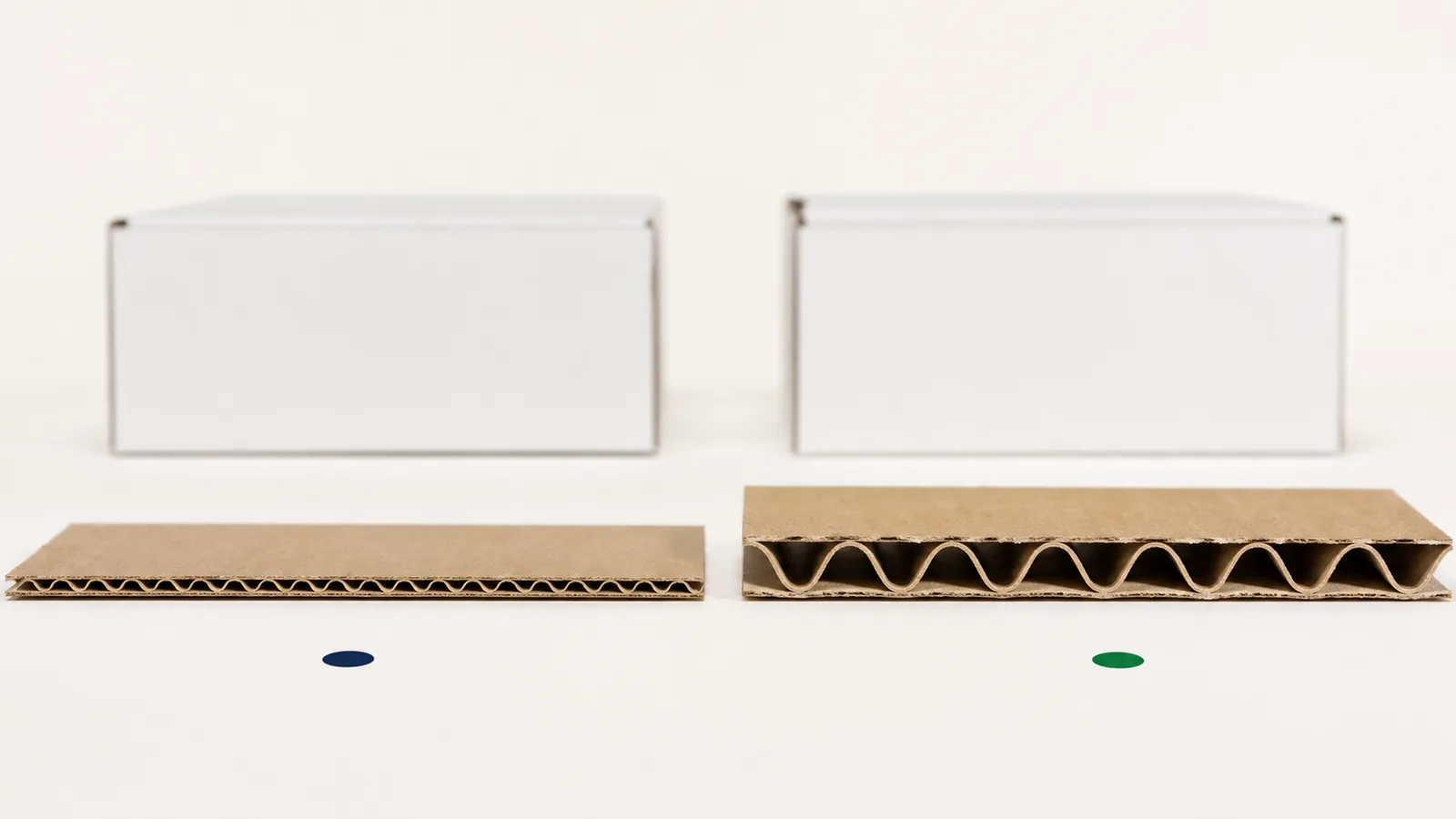
Corrugated board combines liners with a fluted medium. The letters describe flute profiles, not complete performance grades. Nominal dimensions vary by equipment and supplier, but E-flute is commonly around 1.5 mm thick and B-flute around 3 mm. Treat those figures as orientation, not purchase specifications.
| Decision factor | E-flute | B-flute |
|---|---|---|
| Profile | Fine and relatively thin | Coarser and thicker |
| Typical design use | Compact printed packs and retail-style corrugated structures | Larger panels, shippers and packs needing more board depth |
| Print surface | Generally smoother for direct printing | More flute structure may show through, depending on liner and process |
| Storage volume | Lower board thickness can reduce flat-pack volume | Thicker blanks occupy more space |
| Cushioning space | Less flute depth | More flute depth |
| Final decision | Validate board combination and loaded package | Validate board combination and loaded package |
Do not put an assumed edge crush value beside a flute letter. ECT, burst strength and component papers are separate specification fields. Two E-flute boards can perform differently, as can two B-flute boards.
Where E-flute earns its place
E-flute often suits small and medium printed packs when the surface must look refined and the product is not relying on flute depth as its only protection.
Start an E-flute evaluation when:
- the box has a compact footprint;
- print detail or large solid areas matter;
- products are light to moderate and well retained;
- an insert controls movement;
- flat-pack storage is constrained;
- the corrugated pack may also function as a retail or gift presentation;
- finished outside dimensions must stay close to the product.
These are design reasons, not guarantees. A wide, shallow E-flute lid can still bow. A small but dense product can overload a weak insert. A fine flute cannot compensate for a poorly sized box.
When B-flute is worth prototyping
B-flute provides a thicker corrugated section. That can be useful when the box is larger, when more separation from an impact is useful, or when panel behavior and stacking are concerns. It may also make a compact pack feel bulkier and can affect folds, print appearance and master-carton count.
Evaluate B-flute when:
- the product is heavier or has concentrated loads;
- the structure spans a larger unsupported area;
- the contents are fragile and the insert system benefits from more corrugated depth;
- stacking and handling are more demanding;
- the corrugated pack travels without another shipping carton;
- an E-flute prototype shows panel bowing, corner damage or inadequate separation.
A switch to B-flute is not a general cure for damage. If the product moved, the insert may be at fault. If the closure opened, the lock deserves attention. Corner collapse may relate to dimensions, board grade, palletization or handling. Diagnose the failure before changing the flute.
Read the whole board line on the quotation
A quote that says only “E-flute” or “B-flute” is incomplete. Ask for the board combination or performance designation used by the supplier, along with the liner surface and test basis relevant to the project.
The specification should identify:
- flute profile;
- liner and medium basis or supplier board grade;
- kraft, white or coated print surface;
- recycled or virgin fiber claims, with documentation if claimed;
- ECT, burst or other agreed performance value where relevant;
- caliper tolerance;
- print process and coverage;
- coating or lamination;
- grain/flute direction in the die line;
- finished box dimensions and tolerances.
Changing the liner can alter print, rub resistance and stiffness without changing the flute letter. Changing print coverage or coating can also change score behavior and visual scuffing.
The liner and print process still govern appearance
A fine flute can create a smoother direct-print surface, but artwork, liner, ink system, plate, press and coverage still matter. Large dark solids may reveal board variation or handling marks more readily than small graphics. Reverse type and barcodes need enough contrast and quiet area.
For high-detail graphics, suppliers may propose preprinted liner, litho-lamination or another process. That decision changes cost, lead time and recyclability evidence, and it may introduce a film or coating. Approve the actual production construction—not only a digital rendering.
PackagingFor’s offset vs digital printing guide explains why run length, artwork and proof expectations should be specified separately from the box structure.
Equal weight does not mean equal packaging risk
Two products with the same weight can need different mailers. A compact metal item creates a concentrated load. A glass bottle adds breakage and leakage consequences. A soft textile distributes load but may not need an insert. A kit can shift internally even when its total weight is low.
Provide the converter with:
- individual and packed weight;
- product dimensions and orientation;
- fragile or protruding areas;
- center of gravity where relevant;
- number of products per box;
- void-fill or insert design;
- expected stacking and pallet configuration;
- parcel, pallet or retail distribution route.
The box and insert must be designed around the loaded condition.
When the decision is close, cut both samples
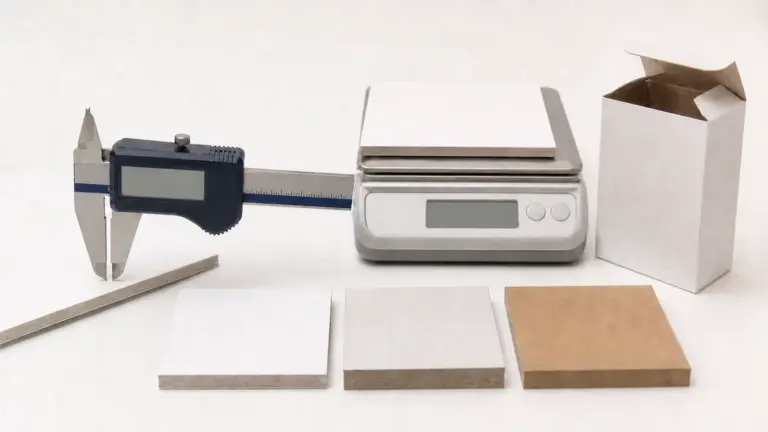
When print appearance and transit protection pull in different directions, produce blank samples in both board options using the same inside dimensions and intended insert. Compare erection, fit, closure, panel bowing, handling behavior, flat-pack volume and master-carton count.
Then test production-equivalent samples. ISTA identifies Procedure 3A for individual packaged products in parcel delivery systems and provides other procedures for other routes; review the official test-procedure overview. A supplier’s sample surviving one informal drop does not establish performance for every distribution environment.
Define acceptable product and package condition before testing. A box may protect the item but show cosmetic corner damage that is unacceptable when the mailer is the customer-facing presentation.
The approval record should contain more than “E” or “B”
Before approving E-flute or B-flute, confirm:
- the exact board, not only the flute letter;
- product and packed weight;
- insert and movement control;
- inside and outside dimensions;
- print sample on the intended liner;
- closure method and tamper requirement;
- assembly and packing time;
- master-carton and pallet efficiency;
- test plan and pass/fail criteria;
- version control if any component changes.
If neither single-wall option performs, the answer may be a different board combination, box geometry, insert or outer shipper—not simply a thicker flute.
Common questions at specification review
Is B-flute stronger than E-flute?
B-flute is thicker, but “stronger” is incomplete without the liner, medium, board grade, box design and test method. Compare complete specifications and loaded-package results.
Is E-flute good for shipping?
It can be, for an appropriately designed and tested product-package system. The product, weight, dimensions, insert and route determine whether a particular E-flute board is suitable.
Which flute prints better?
E-flute generally provides a finer direct-print surface. Actual print quality also depends on the liner, printing process, artwork and finish.
Does thicker corrugated always reduce damage?
No. Damage can result from movement, poor fit, concentrated loads, weak closures or an unsuitable distribution system. Diagnose the failure before changing flute.
Put the board choice into a testable specification
PackagingFor manufactures custom mailer boxes and other corrugated packaging in constructions selected around product fit, print and route. Packed product data gives the converter enough information to compare E-flute, B-flute or another construction on the same basis.